

Choosing the right hearing aid brand comes down to a few daily priorities, whether that’s natural sound processing, invisible comfort, or seamless smartphone connectivity. This comparison breaks down how industry leaders like Phonak, Oticon, ReSound, Signia, and Widex compare head-to-head so you can make a confident decision.
Hearing aids provide great support to those with special hearing needs. However, not every unit provides the same experience, which is why the best hearing aids can vary from user to user. Some might want one that offers great value for the lowest price without compromising sound quality. Others might want to invest in a more premium model with features that suit their lifestyle.
Different hearing aid brands are best for different customers. If you are researching the best hearing aid brands, it helps to compare the major names side by side before making a decision. For users seeking mid-range to premium options, these hearing aid manufacturers are highly recommended: Phonak, Oticon, ReSound, Signia, and Widex.
Popular Hearing Aid Brands
The best hearing aid brands depend on what you’re looking for in terms of technology, comfort, sound quality, and features that match your everyday life – all within your budget.
Here is a quick comparison of these popular hearing aid brands:
|
Brand |
Known For |
Typical Price Range |
Best For |
|
Strong performance in challenging listening environments |
Mid to premium |
Active users, Android users, people wanting versatile connectivity |
|
|
Oticon |
Natural sound processing |
Mid to premium |
Users wanting natural sound and all-day comfort |
|
Connectivity and app experience |
Mid to premium |
Tech-focused users, iPhone users, people who like app control |
|
|
Modern features and speech enhancement |
Mid to premium |
Social users, style-conscious buyers, rechargeable seekers |
|
|
Sound quality and music listening |
Mid to premium |
Music lovers, users sensitive to sound quality |
Whether you are deciding between Oticon vs. ReSound for smartphone features or Widex vs. Phonak for sound processing, the right choice comes down to your personal listening environments, device compatibility, and budget.
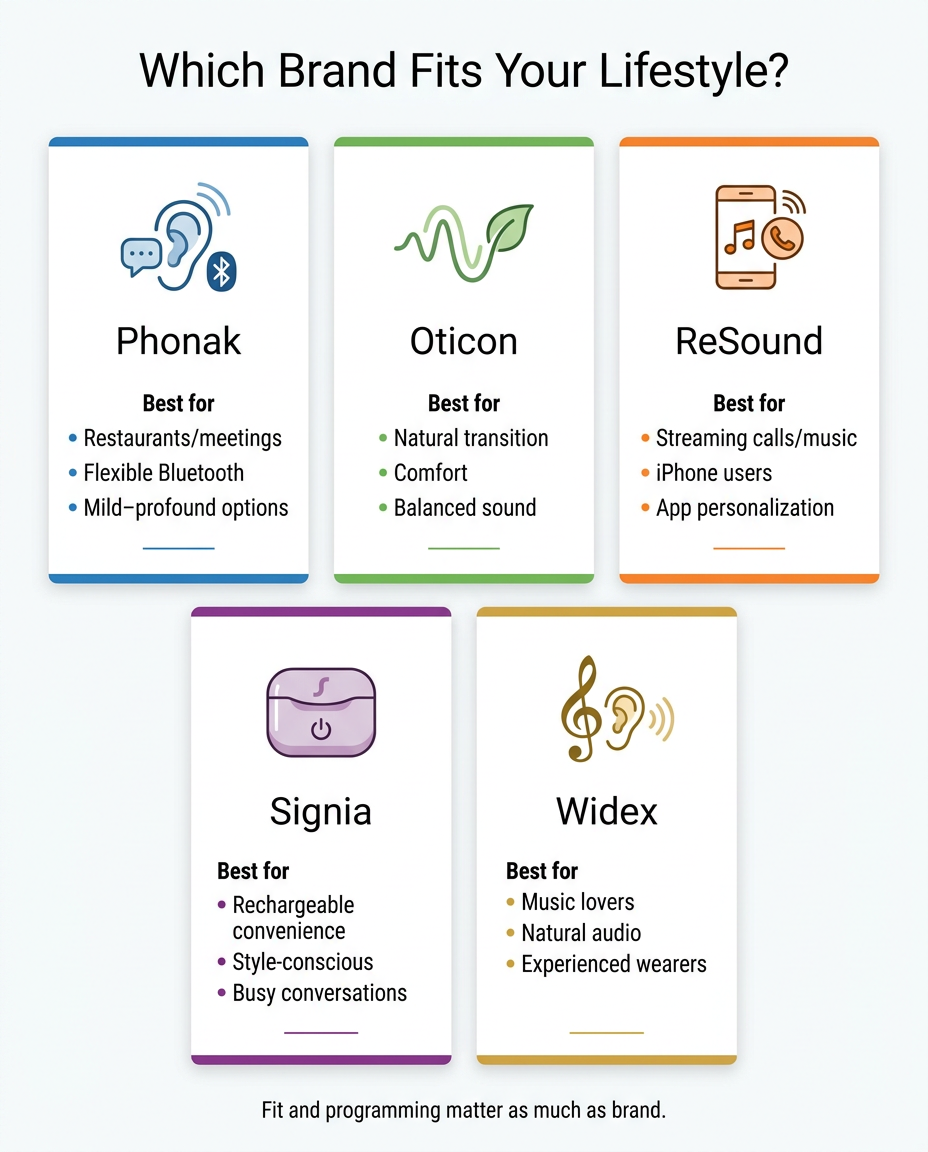
Phonak
Phonak is one of the most recognized names in hearing care. The company is known for dependable performance, strong speech understanding, and compatibility with many phones and devices.
|
Pros |
Cons |
|
|
Best For:
- People who spend time in restaurants, meetings, or group settings
- Users who want flexible Bluetooth connectivity
- Buyers looking for a trusted, all-around performer
If you’re comparing Resound vs Phonak hearing aids (or Phonak vs Resound hearing aids), a common deciding factor is whether you want Phonak’s versatile Bluetooth compatibility and strong speech-in-noise performance versus ReSound’s app-driven personalization and streaming experience.
Oticon
Oticon is known for a sound philosophy that aims to give wearers access to a fuller sound environment rather than narrowing focus too aggressively. For many people, that creates a more natural listening experience.
|
Pros |
Cons |
|
|
Best For:
- First-time users who want a more natural transition into hearing aids
- Wearers who value comfort and balanced sound
- People who want premium technology with a refined listening experience
People comparing Oticon vs Resound or Resound hearing aids vs Oticon are often weighing Oticon’s open, natural sound approach against ReSound’s connectivity and app control.
ReSound
ReSound is a major player among popular brands, especially for users who want modern connectivity features. The brand is well known for smartphone integration, streaming convenience, and flexible personalization through its app.
|
Pros |
Cons |
|
|
Best For:
- Tech-savvy users
- People who stream calls, music, or media often
- Buyers who want hands-on app control over settings
If your main comparison is Resound vs Oticon (or Resound hearing aids vs Pticon), your “best” answer may depend on whether you prioritize streaming/app customization (ReSound) or a more natural, open listening feel (Oticon).
Signia
Signia (formerly Siemens) has built a strong reputation for sleek design, rechargeable technology, and useful features for people who spend a lot of time communicating in busy environments. It is often considered among the best brands for users who want modern style and performance.
|
Pros |
Cons |
|
|
Best For:
- Socially active adults
- Users who want rechargeable convenience
- Buyers who care about both appearance and performance
For shoppers typing Signia vs Phonak vs resound, the “top” choice usually comes down to: Signia for sleek rechargeables and conversation support, Phonak for performance in complex noise plus broad Bluetooth, and ReSound for app and streaming.
Widex
Widex stands out for its sound quality, especially for users who are highly sensitive to how hearing aids reproduce music and subtle sound detail. Many experienced wearers appreciate Widex for its smooth and natural listening experience.
|
Pros |
Cons |
|
|
Best For:
- Music lovers
- Experienced hearing aid users with strong sound preferences
- People prioritizing natural audio quality
Most people comparing Widex vs Phonak hearing aids will often have sound character as the main deciding factor: Widex is frequently chosen for music realism and smoothness, while Phonak is commonly chosen for all-around performance and connectivity.
Factors To Consider When Shopping for the Best Hearing Aid Brands
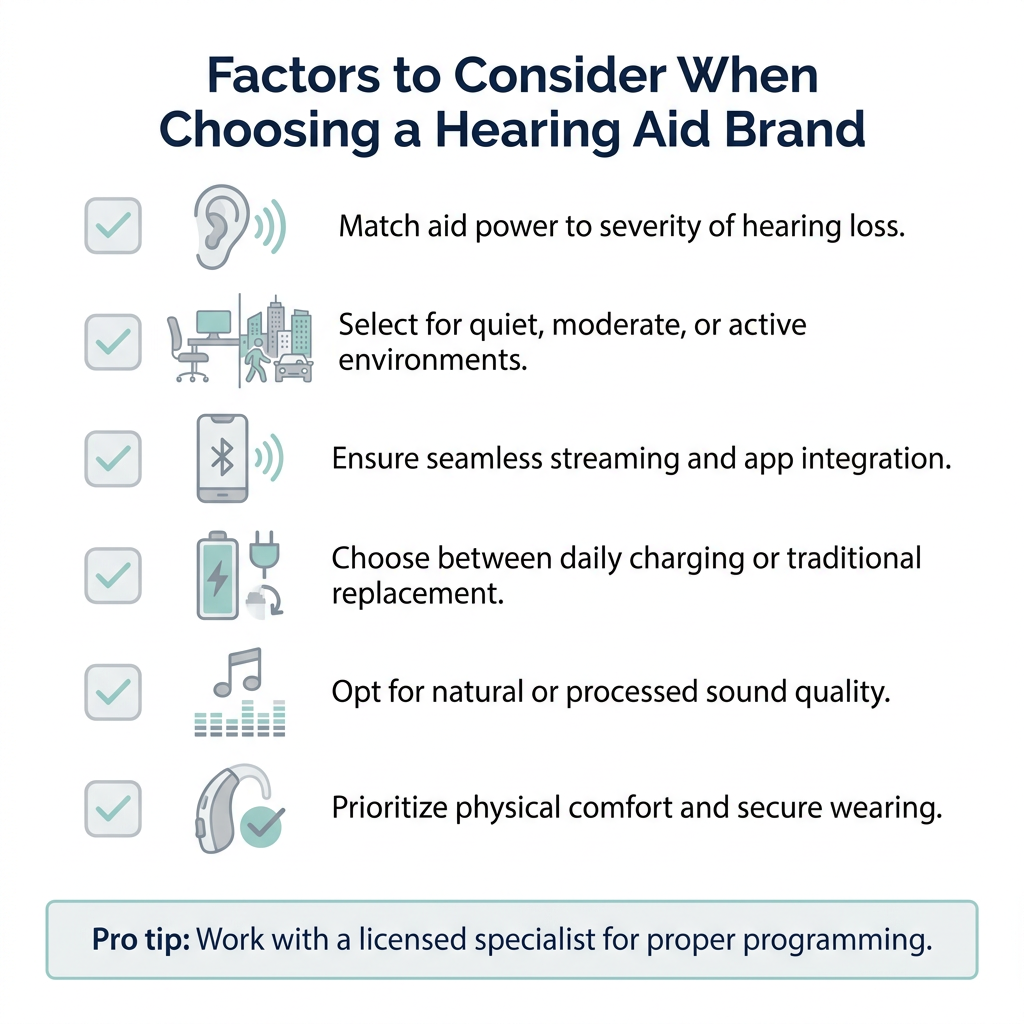
Even among the popular hearing aid brands, the right choice depends on more than brand recognition alone. Consider the following before you buy:
-
Hearing Loss Levels: Mild, moderate, severe, and profound hearing loss may call for different device styles and power levels.
-
Lifestyle: If you spend time in crowds, meetings, restaurants, or outdoor settings, noise management features may be a good investment.
-
Bluetooth and Phone Compatibility: Some brands work especially well with certain phones, apps, and accessories.
-
Rechargeable vs. Disposable Batteries: Rechargeable hearing aids are convenient, while some prefer units that use disposable batteries.
-
Sound Preference: Some people prefer a crisp, speech-focused sound, while others want a softer, more natural listening experience.
-
Comfort and Fit: A hearing aid can have great technology, but it still needs to feel comfortable enough for daily wear.
To select the best brand faster, you can decide on your top priority among:
- Speech clarity in noise
- Natural sound
- Streaming/app control
- Music fidelity
Once you’ve decided, compare the “vs” matchups based on that angle.
Why Shop at Wholesale Hearing Direct
Wholesale Hearing Direct offers access to several of the industry’s popular hearing aid brands while helping customers save significantly compared to traditional retail pricing. Our direct-to-consumer model is designed to make premium prescription hearing aids more affordable without giving up professional support.
-
Lower Pricing: Customers can often save thousands versus typical retail stores and clinics.
-
Licensed Professional Support: Our licensed hearing specialists can adjust your hearing aids according to your prescription.
- Remote Adjustments: Support does not stop after the sale. Submit your hearing test, place your order, receive programming, and have it delivered to your home.
Find the Best Hearing Aids at Wholesale Hearing Direct
Each brand brings something different to the table. If you are ready to compare the hearing aid brands and find the right fit, Wholesale Hearing Direct can help you explore leading options at competitive prices. Browse available models or reach out to our team for help choosing the right hearing aid for your lifestyle and budget.
If you tell our team what you’re comparing (for example: Oticon vs Resound, Widex vs Phonak hearing aids, or Oticon vs resound vs Phonak), we can help narrow down the best fit based on your hearing test and goals.
FAQ: Best Hearing Aid Brand Comparisons (Phonak vs Oticon vs ReSound vs Signia vs Widex)
1) What is the best hearing aid brand overall?
There isn’t a single “best” brand for everyone. The best hearing aid brand depends on a variety of different factors, including your hearing loss level, lifestyle (quiet vs noisy places), sound preference (crisp vs natural), and phone needs (streaming/app control). While Phonak, Oticon, ReSound, Signia, and Widex are all top-tier options, the right pick is the one that matches your day-to-day environments.
2) Which is better: Widex vs Phonak hearing aids?
Among Widex vs Phonak hearing aids, Widex is often favored by people who prioritize smooth, natural sound and music fidelity, while Phonak is often chosen for strong speech understanding in noisy places and flexible Bluetooth connectivity. The “better” choice depends on whether you value sound character (Widex) or all-around versatility (Phonak).
3) How do I choose between Oticon vs Resound?
With Oticon vs Resound, many wearers choose Oticon for a more open, natural listening style and all-day comfort, while ReSound is frequently picked for its app controls, streaming features, and personalization. If you stream calls/music often, ReSound may feel like the better fit; if you want a natural, balanced sound, Oticon may stand out.
4) Is there a real difference between Resound hearing aids vs Oticon?
Yes, there are some subtle differences. The choice between Resound hearing aids vs Oticon often comes down to sound philosophy and user controls. ReSound tends to emphasize user-driven personalization through its app and streaming experience, while Oticon emphasizes an open sound approach designed to help you access more of your environment.
5) What’s the difference between Phonak vs Resound hearing aids?
In Phonak vs Resound hearing aids, Phonak is commonly known for strong performance in complex listening environments and broad Bluetooth compatibility, while ReSound is well known for streaming and app-based fine-tuning. If you’re frequently in restaurants or group conversations, Phonak may be appealing; if you want app control and streaming, ReSound may be a better match.
6) Which is better: Resound vs Phonak hearing aids for phone calls and streaming?
For Resound vs Phonak hearing aids, both can do calls and streaming well, but the “best” experience depends on your phone and how much you want to control settings from an app. ReSound is often a top choice for people who want hands-on app control; Phonak is often a top pick for people who want flexible Bluetooth connectivity across many devices.
7) How should I think when selecting among Oticon vs Resound vs Phonak?
When comparing Oticon vs Resound vs Phonak, a simple way to decide is:
- Oticon: natural, open sound approach
- ReSound: app/streaming and personalization
-
Phonak: versatile connectivity and strong speech-in-noise performance
Your best match depends on which of those priorities matters most to you.
8) What does Signia vs Phonak vs Resound come down to?
For Signia vs Phonak vs Resound, the decision is often about feature priorities: Signia is frequently chosen for sleek styles and rechargeable convenience, Phonak for performance and connectivity flexibility, and ReSound for app experience and streaming features. Your hearing specialist’s programming also plays a big role in final results.
9) Can I compare resound vs Oticonwidex vs Phonak vs Oticon without getting overwhelmed?
Yes. If you’re comparing multiple brands at once (including Resound vs Oticon, Widex vs Phonak vs Oticon), narrow it down by (1) your main listening challenge (noise, comfort, music, streaming), (2) your phone compatibility needs, and (3) which sound profile you prefer. Then test your top 2–3 options with professional programming.